Web and API Access Management
Enterprise-class Web and API Unified Access Control Platform

Key Functions
Unified Access Management
Supports unified access and centralized management for web applications, Open APIs, internal service interfaces, and third-party services, establishing a unified access portal to reduce management complexity and security risks caused by decentralized system exposure.
API Lifecycle Management
Provides full-process management capabilities from API design, registration, publishing, and deprecation to version maintenance, supporting standardized governance and unified accumulation of interface assets to enhance the reusability and manageability of enterprise API assets.
Unified Authentication and Authorization
Supports diverse identity authentication and authorization mechanisms, including but not limited to API Key, OAuth2, JWT, OIDC, LDAP, and mTLS, achieving centralized authentication and authorization management of access relationships among users, applications, systems, and services.
Fine-Grained Access Control
Achieves hierarchical access control for Web and APIs through precise control over dimensions such as access subjects, access paths, request methods, source addresses, time conditions, interface resources, and invocation scopes, satisfying differentiated security requirements in various business scenarios.
Traffic Governance and Service Protection
Supports multiple governance capabilities including rate limiting, circuit breaking, degradation, load balancing, timeout control, and black/white lists to ensure stable service operation under high-concurrency scenarios, improving critical business continuity and system availability.
Unified Access Management
Supports unified access and centralized management for web applications, Open APIs, internal service interfaces, and third-party services, establishing a unified access portal to reduce management complexity and security risks caused by decentralized system exposure.
API Lifecycle Management
Provides full-process management capabilities from API design, registration, publishing, and deprecation to version maintenance, supporting standardized governance and unified accumulation of interface assets to enhance the reusability and manageability of enterprise API assets.
Unified Authentication and Authorization
Supports diverse identity authentication and authorization mechanisms, including but not limited to API Key, OAuth2, JWT, OIDC, LDAP, and mTLS, achieving centralized authentication and authorization management of access relationships among users, applications, systems, and services.
Fine-Grained Access Control
Achieves hierarchical access control for Web and APIs through precise control over dimensions such as access subjects, access paths, request methods, source addresses, time conditions, interface resources, and invocation scopes, satisfying differentiated security requirements in various business scenarios.
Unified Access Management
Supports unified access and centralized management for web applications, Open APIs, internal service interfaces, and third-party services, establishing a unified access portal to reduce management complexity and security risks caused by decentralized system exposure.
API Lifecycle Management
Provides full-process management capabilities from API design, registration, publishing, and deprecation to version maintenance, supporting standardized governance and unified accumulation of interface assets to enhance the reusability and manageability of enterprise API assets.
Unified Authentication and Authorization
Supports diverse identity authentication and authorization mechanisms, including but not limited to API Key, OAuth2, JWT, OIDC, LDAP, and mTLS, achieving centralized authentication and authorization management of access relationships among users, applications, systems, and services.
Fine-Grained Access Control
Achieves hierarchical access control for Web and APIs through precise control over dimensions such as access subjects, access paths, request methods, source addresses, time conditions, interface resources, and invocation scopes, satisfying differentiated security requirements in various business scenarios.
Traffic Governance and Service Protection
Supports multiple governance capabilities including rate limiting, circuit breaking, degradation, load balancing, timeout control, and black/white lists to ensure stable service operation under high-concurrency scenarios, improving critical business continuity and system availability.
Protocol Conversion and Service Orchestration
Supports unified access and conversion of multiple access protocols like HTTP, HTTPS, REST, and WebSocket, helping enterprises mask backend service differences, improving integration efficiency between new and legacy systems, and supporting business-scenario-oriented service composition and invocation link governance.
Product Technology Features
●Revolving around the two core scenarios of enterprise web application access and API service opening, it provides unified portal, unified policy, unified auditing, and unified governance capabilities, avoiding redundant investments and management fragmentation caused by decentralized Web and API construction.
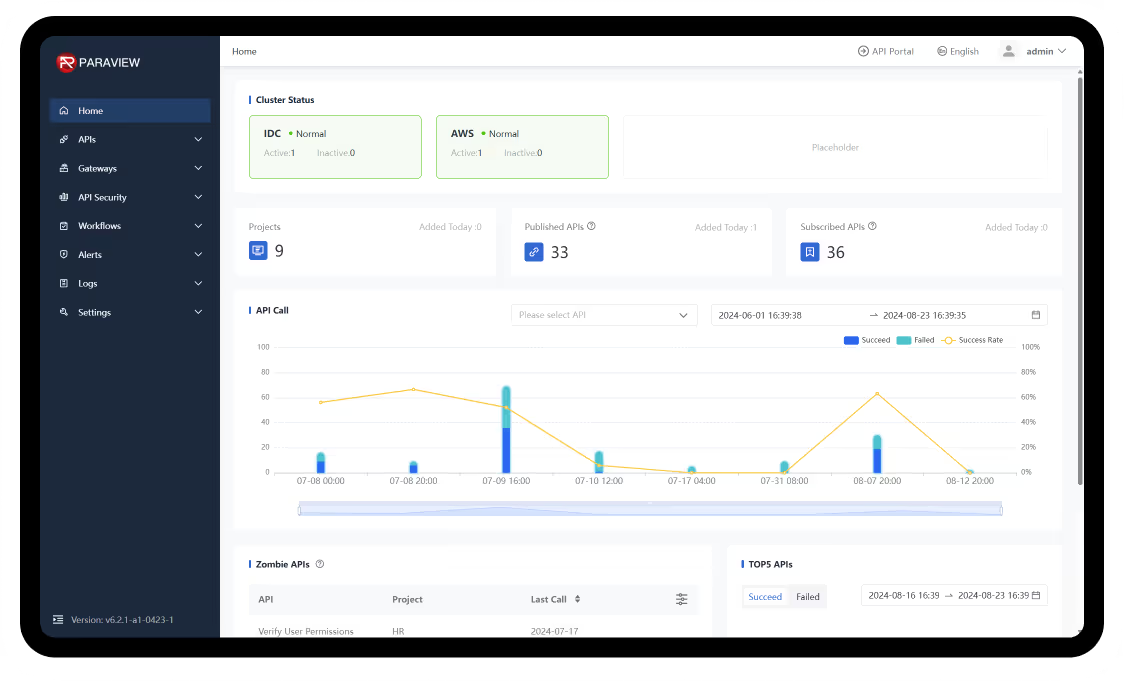
●Compatible with mainstream authentication protocols, access protocols, and service interface formats. It can adapt to application systems, microservices, and third-party platforms at different architecture stages, reducing system integration costs and accelerating business rollout.
Meets the needs for internal enterprise system access control and security isolation, while also supporting API opening capabilities for partners, developers, and ecosystems, improving business connection efficiency under the premise of being secure and controllable.
●Through multi-dimensional access policy configuration, it achieves fine-grained control from the interface and application levels down to the caller level, satisfying the high requirements for access security and data protection in industries such as finance, government, manufacturing, and retail.
Use Cases
Use Cases
Business Benefits
● Builds a unified Web and API access management center for enterprises, achieving centralized control of access portals, authentication and authorization, traffic governance, and security auditing.
● Standardizes enterprise interface publishing and access management processes, reducing risks such as interface abuse, unauthorized invocation, service loss of control, and data exposure.
● Through unified access control and service governance capabilities, it improves enterprise internal system integration efficiency and external service open capabilities, accelerating business collaboration and ecosystem connections.
● By building a standardized API asset management and open service system, it improves interface reusability and platform-based operational capabilities.
● Through unified logging, monitoring, and auditing capabilities, it improves operational efficiency and issue traceability, meeting enterprise security compliance and governance requirements.
● On the basis of ensuring access security and system stability, it helps enterprises achieve more efficient service delivery capabilities, lower integration costs, and faster business response speeds.
Related Case Studies


Ready to Embrace a Safe and Efficient Digital World?
Contact us and Let’s discuss how Paraview can secure your identity and API assets.